- Introduction
- Different Types of Data
- Methods of Data Collection
- Data Analysis
- Summary Statistics
- Displaying Data
- Probability
- Distributions
- Testing Statistical Hypothesis
- Purpose of Statistical Tests
- Formalism Used
- Different Types of Tests
- z Test for a Single Mean
- z Test for Two Means
- t Test for a single mean
- t Test for Two Means
- paired t Test for comparing Means
- One-Way ANOVA F Test
- z Test for a Single Proportion
- z Test for Two Proportions
- Testing whether Proportion A Is Greater than Proportion B in Microsoft Excel
- Spearman's Rank Coefficient
- Pearson's Product Moment Correlation Coefficient
- Chi-Squared Tests
- Approximations of distributions
- Point Estimates </span> as of 12:07, 28 March 2007 (UTC)"}'>
 (12:07, 28 March 2007 (UTC))
- Unbiasedness
- Measures of goodness
- UMVUE
- Completeness
- Sufficiency and Minimal Sufficiency
- Ancillarity
- Practice Problems
- Numerical Methods
- Time Series Analysis
- Multivariate Data Analysis
- Analysis of Specific Datasets
- Appendix

Geometric Mean
The Geometric Mean is calculated by taking the nth root of the product of a set of data.
![{\displaystyle {\tilde {x}}={\sqrt[{n\;}]{\prod _{i=1}^{n}x_{i}}}}](https://wikimedia.org/api/rest_v1/media/math/render/svg/74c79b93aee3d08c24efa85fcb7915abbd1299a6)
For example, if the set of data was:
1,2,3,4,5
The geometric mean would be calculated:
![{\displaystyle {\sqrt[{5}]{1\times 2\times 3\times 4\times 5}}={\sqrt[{5}]{120}}=2.61}](https://wikimedia.org/api/rest_v1/media/math/render/svg/93eafbb54fcdb93e7a1fbf33deaeb56cc2d5147c)
Of course, with large n this can be difficult to calculate. Taking advantage of two properties of the logarithm:


We find that by taking the logarithmic transformation of the geometric mean, we get:
![{\displaystyle \log \left({\sqrt[{n}]{x_{1}\times x_{2}\times x_{3}\cdots x_{n}}}\right)={\frac {1}{n}}\sum _{i=1}^{n}\log(x_{i})}](https://wikimedia.org/api/rest_v1/media/math/render/svg/d15c11d0ebbf72852ac644ce767c87468ebeb754)
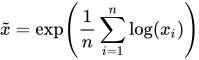
Which leads us to the equation for the geometric mean:
When to use the geometric mean
The arithmetic mean is relevant at any time several quantities add together to produce a total. The arithmetic mean answers the question, "if all the quantities had the same value, what would that value have to be in order to achieve the same total?"
In the same way, the geometric mean is relevant any time several quantities multiply together to produce a product. The geometric mean answers the question, "if all the quantities had the same value, what would that value have to be in order to achieve the same product?"
For example, suppose you have an investment which returns 10% the first year, 50% the second year, and 30% the third year. What is its average rate of return? It is not the arithmetic mean, because what these numbers mean is that on the first year your investment was multiplied (not added to) by 1.10, on the second year it was multiplied by 1.50, and the third year it was multiplied by 1.30. The relevant quantity is the geometric mean of these three numbers. Written by Hafiz G m
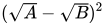
It is known that the geometric mean is always less than or equal to the arithmetic mean (equality holding only when A=B). The proof of this is quite short and follows from the fact that